
Radiation damage in metals


Cascades

A high energy neutron entering a metal soon collides with one or more ions of the material. These ions exchange energy with the other ions and with the electrons along their path and are brought to rest in displacement spikes: localised regions of concentrated damage. Over tens of picoseconds these displacement spikes cool and a final defect concentration is established. These defect populations determine the microstructural evolution of the metal. The exchange of energy between ions and electrons is thus critically important in determining the useful (and safe) life of materials under neutron bombardment.

These simulations require large simulation sizes and long evolution times, and so must be performed in parallel.
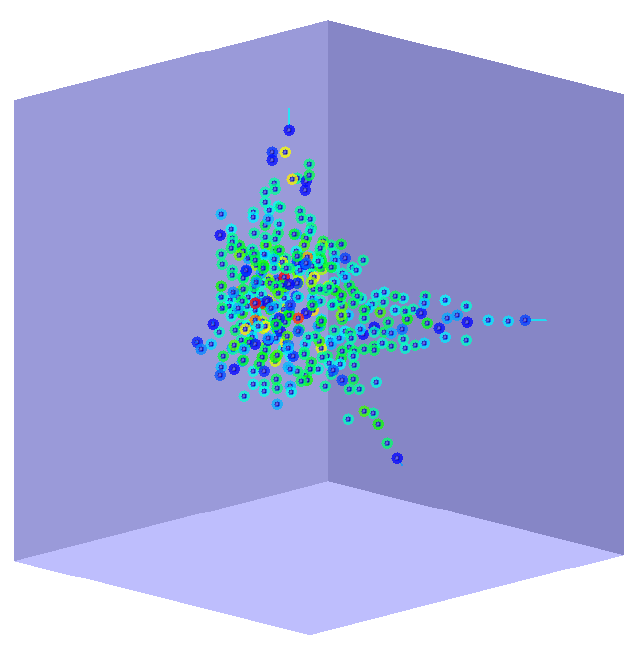
snapshot of cascade evolution
A snapshot taken 100fs into a cascade simulation. One atom was given a kinetic energy of 1keV at time t=0. The simulation cell is 13440 atoms, with periodic boundary conditions applied. Only atoms which have moved >0.25A are shown. The colours represent the charges on the atoms, with blue (-10%|e|) through green (neutral) to red (+10%|e|).