
Radiation damage in metals


Electronic Damping

The transfer of energy between ions in a metal is well modelled by classical molecular dynamics simulations. Energy transfer between ions and electrons is less well understood; theoretical work has been confined to highly idealised situations and simulations have at best treated the electrons implicitly as a viscous drag on moving ions. Literature estimates of energy loss to the electrons vary by several orders of magnitude. Our project takes the modelling of collision cascades to the next level of sophistication, going beyond the Born-Oppenheimer approximation. By applying Ehrenfest dynamics in a time-dependent tight-binding simulation we (i) treat the electrons explicitly and quantum mechanically and (ii) determine their evolution under the influence of a Hamiltonian that explicitly includes the positions of classical ions. We obtain quantitative estimates of the energy transfer from ions to electrons.

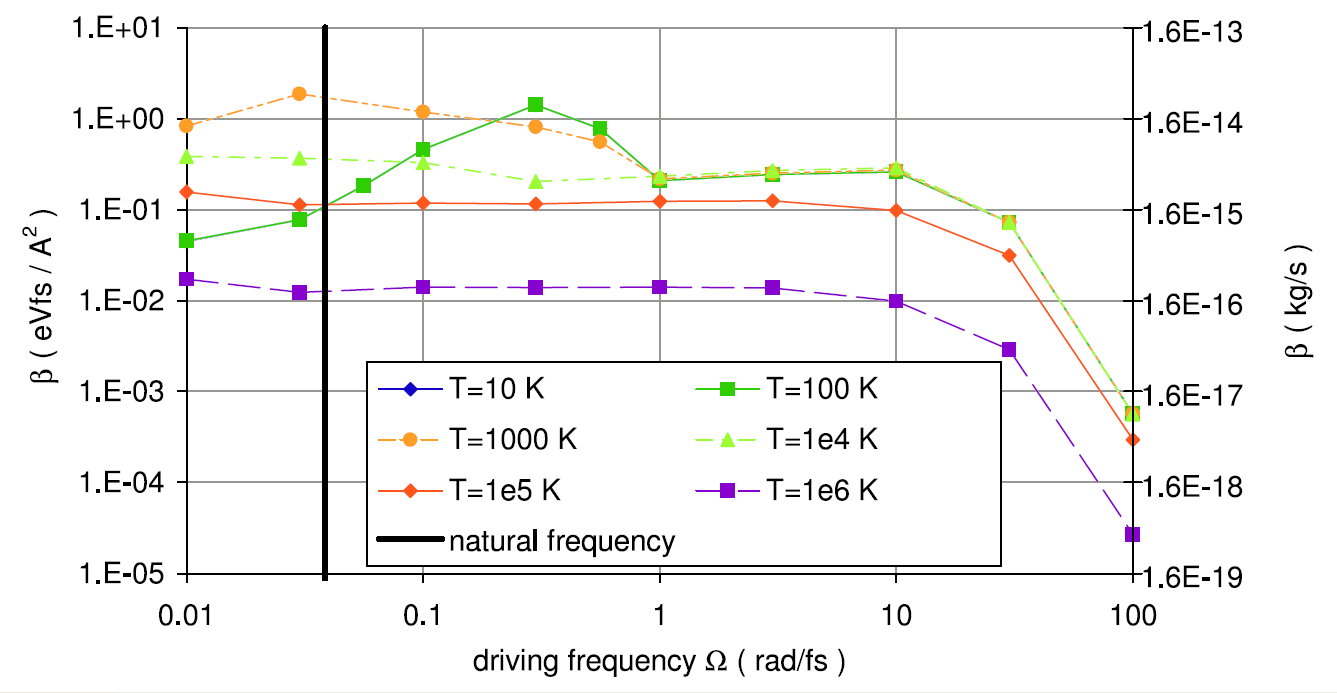
As a preliminary to a full investigation of electronic damping we have thoroughly investigated a surprisingly informative toy model: that of a single atom forced to vibrate at constant angular frequency Ω in an otherwise rigid perfect lattice. The frequencies were chosen to be relevant to the simulation of radiation damage in metals. A damping coefficient β was measured by comparing the irreversible energy transfer to the electronic subsystem with the expected power loss from a classical driven damped harmonic oscillator. Our results show that at high electronic temperatures the damping due to the electronic system is frequency independent. However for temperatures below 104 K and angular frequencies up to 10 rad fs-1 the damping varies depending on the frequency of oscillation. This parameter regime is that which is encountered in irradiation damage experiments.
published data showing damping coefficient as a function of driving frequency
Our published data showing damping coefficient β as a function of driving frequency Ω. See JPCM 19 (2007) 436209.


Our latest set of experiments have measured the rate of irreversible energy transfer when all atoms are in motion. One atom is given a kick of kinetic energy and then the system evolved. Here it is less simple to define a damping coefficient as the ionic trajectories correspond to a non-adiabatic evolution, but it is possible to compare the electronic energy at time t with the instantaneous ground state electronic energy. We have found that this difference is a function of the direction in which the first atom initially moves. This means that the energy loss from classical ions cannot be correctly described by an homogeneous isotropic damping coefficient.
irreversible energy transfer as a function of PKA direction
The irreversible energy, shown as different colours, transfered from ionic to electronic subsystems, as a function of the direction of the first moving atom in the cascade. To generate this image one atom has been given a kinetic energy of 100eV and the system evolved for 50fs. The system transfers of 2.5eV if the initial direction is [110]. Only 0.5eV is transferred in the same time when the atom is given the same energy but in the [100] direction.