
Radiation damage in metals


Introduction

See also our video introduction on the research page.
A high energy neutron entering a metal transfers kinetic energy to ions of the material. Set in motion an ion interacts with other ions and electrons along its path, leaving a trail of damage. Over tens of picoseconds the damaged region cools and a final defect population is established, setting conditions for long term microstructural evolution. Understanding the damage caused and the rate at which energy is exchanged with the electrons is critical in determining the useful lifetime of metallic materials under neutron bombardment.

Previous radiation damage simulations have used classical molecular dynamics (MD) with electrons treated implicitly via a simple damping coefficient. We model the evolution of the electrons in response to a Hamiltonian explicitly dependent on ionic configuration, and can measure the irreversible transfer of energy into the electronic subsystem, and determine the effect of electronic excitation and charge states of ions. This has revealed the dependence of electronic damping on atomic environment, ionic motion and temperature. We are now exploring non-adiabatic force corrections, looking specifically at collision sequences: an important mechanism for producing Frenkel defects, and look to a more sophisticated treatment of electronic energy loss in MD.

radiation damage electronic forces

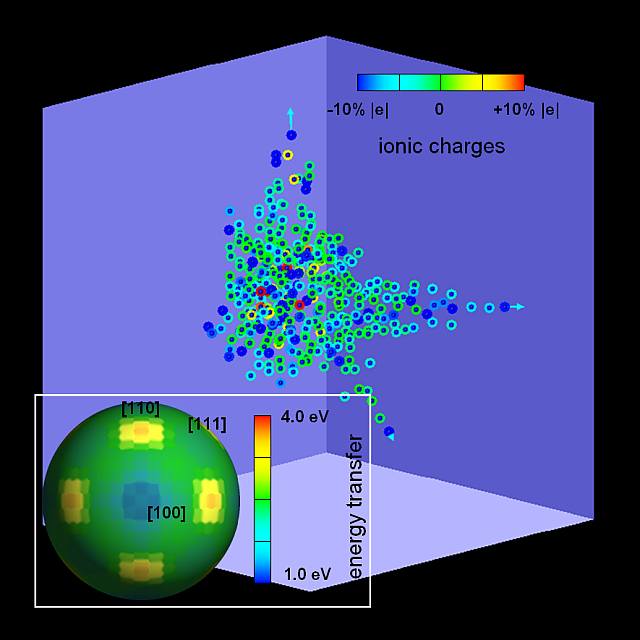
Displaced atoms 100fs into a 1keV cascade.
Inset: irreversible energy transfer as a function of initial ion direction.

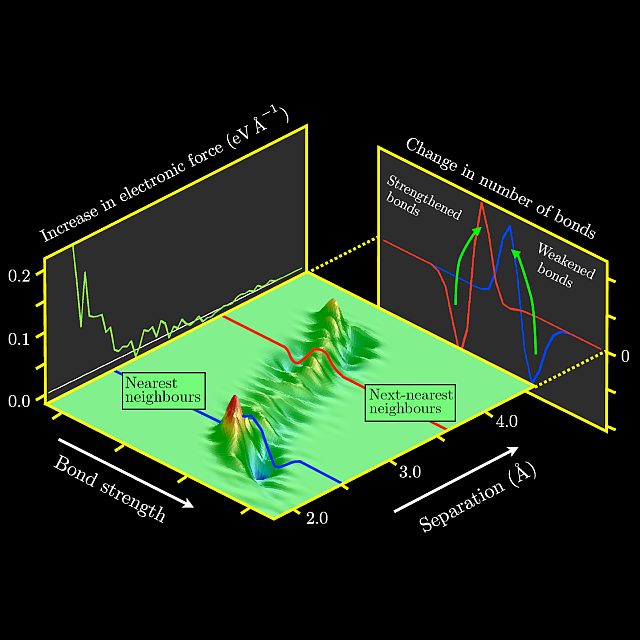
Non-adiabatic force corrections due to electronic excitation by fast moving ions.